
Diners Club at UK Online Casinos: Deposits and Terms
 Available in GB
Diners Club availability depends on the casino’s cashier and terms, while bonus eligibility, withdrawals and account controls have separate conditions.

Table of Contents
- Diners Club, Online Slots and Bonus Eligibility
- Deposit Availability and Cashier Checks
- Can Diners Club Be Used at an Online Casino?
- Card Acceptance, Debit Cards and the Credit-Card Ban
- Diners Club and Online Slot Play
- Other Ways to Fund an Online Casino Account
- Checking a Casino’s Diners Club Card Terms
- Withdrawals, Original-Source Rules and Timing
- Depositing by Card: Timing, Currency and Costs
- Diners Club, GAMSTOP and Account Controls
Diners Club, Online Slots and Bonus Eligibility
A slot promotion has two separate conditions: the game must qualify, and the deposit method must qualify. A bonus advertised for online slots does not, by itself, establish that a Diners Club deposit can be used to claim it. Nor does a successful deposit guarantee that the payment route is eligible for a promotion. Those are separate terms, and the promotion rules control the second question.
For anyone comparing a Diners Club deposit with a slots offer, the useful detail is not the headline bonus figure but the offer’s payment-method wording. Terms may identify eligible methods, exclude particular routes, or make eligibility conditional on how the deposit is made. If the wording does not clearly cover Diners Club, the offer should not be treated as available on that basis. A displayed promotion is an invitation under stated conditions, not a confirmation that every deposit method qualifies.
This distinction matters because an account can be able to play slots without a particular deposit being eligible for a bonus. The promotional balance, if awarded, is also governed by its own terms. A slot may be included in an offer while a deposit made through a particular route is not eligible to trigger it. Conversely, an eligible payment route does not mean every slot or every promotion has the same conditions. Payment eligibility and game eligibility need to be read independently.
Use this list as a starting point when looking into UK casinos connected with Diners Club. The details provided here cover payout speed only, so check each casino’s payment options directly to confirm whether it accepts Diners Club.
Payout speed: 1-3 business days Revery Play has a stated payout speed of 1–3 business days. The information provided does not specify whether it accepts Diners Club.
Payout speed: 1-3 business days Chanze has a stated payout speed of 1–3 business days. The information provided does not specify whether it accepts Diners Club.
Payout speed: 1-3 business days Jetsetspins has a stated payout speed of 1–3 business days. The information provided does not specify whether it accepts Diners Club.
Payout speed: 1-3 business days SpinFormula has a stated payout speed of 1–3 business days. The information provided does not specify whether it accepts Diners Club.
Payout speed: 1-3 business days Dieselwin has a stated payout speed of 1–3 business days. The information provided does not specify whether it accepts Diners Club.
Payout speed: 1-3 business days WinBeast has a stated payout speed of 1–3 business days. The information provided does not specify whether it accepts Diners Club.
Payout speed: 1-3 business days x3bet has a stated payout speed of 1–3 business days. The information provided does not specify whether it accepts Diners Club.
Payout speed: 1-3 business days EvoSpin has a stated payout speed of 1–3 business days. The information provided does not specify whether it accepts Diners Club.
Payout speed: 1-3 business days NightLuck has a stated payout speed of 1–3 business days. The information provided does not specify whether it accepts Diners Club.
Payout speed: 1-3 business days Britsino has a stated payout speed of 1–3 business days. The information provided does not specify whether it accepts Diners Club.
A specialist casino review has described PayPal as popular for speed and convenience while noting that it may be excluded from bonus eligibility. That is a report about one payment method, not a rule that can be transferred to Diners Club or applied across casinos. It illustrates why general statements about a method’s convenience do not settle its promotional treatment. The operator’s current offer terms are the relevant document for a specific promotion.
The same discipline applies to searches for casinos with Diners Club accounts, slot deposits or bonuses. A list of slot games says nothing about whether Diners Club is an eligible deposit route. A bonus page saying “new customers” or “first deposit” does not necessarily say which payment methods count. The key terms are the ones that connect the payment method to the offer: whether that method is accepted for the transaction and whether a deposit made with it qualifies for the promotion. Without both conditions, the bonus value cannot be included in a meaningful comparison.
The arithmetic can be simple even when the wording is not. A headline offer has no promotional value if the chosen payment route is excluded or if the deposit does not satisfy the stated eligibility conditions. The relevant comparison is therefore not just the advertised bonus against another casino’s offer. It is the bonus actually available under the payment method, followed by the conditions attached to using it. A larger headline amount can be less useful than a smaller offer whose terms clearly apply to the intended deposit.

Slot-specific terms deserve the same attention. Promotions may restrict which games count towards their conditions, so the presence of online slots in the casino does not establish that all slots contribute equally to an offer. The game list and the payment rules answer different questions. Where the offer names eligible games, that list determines the game side; where it names eligible payment methods, that wording determines the deposit side. Neither should be inferred from the other.
The practical conclusion is narrow: Diners Club should not be treated as a route to a slots bonus merely because a casino advertises slots or a welcome offer. Eligibility depends on the specific promotion terms and their treatment of the deposit method. If that connection is not explicit, the bonus should be valued as unavailable for that transaction rather than counted at its headline amount. This avoids confusing a casino’s game catalogue, its promotional marketing and the terms that govern a particular deposit.
Deposit Availability and Cashier Checks
A payment method is not a standing feature of every casino account. The available choices can depend on the operator, the cashier shown to a particular customer and the payment product being used. A method named in a general payment summary is therefore a prompt to check the live deposit screen, not confirmation that it is available for a specific transaction.
Attention: A card logo displayed on a website does not guarantee that the card can be selected at checkout; availability must be verified in the live cashier.
For Diners Club, the useful check is whether the cashier explicitly presents it as a deposit option. A card logo elsewhere on a site does not establish that the card can be selected at checkout. Nor does a general statement about cards settle the question for every card brand or product. The cashier is where the available options and transaction conditions should be read together.
This distinction matters when looking at casino pages that mention Visa and Mastercard. A specialist casino review may list those networks, but the information can become outdated and does not establish current UK availability or eligibility for a particular card product. The operator’s cashier is the relevant place to confirm what can be used at the time of deposit. A listed network is not a substitute for a visible, selectable method.
What to check before confirming a deposit
The cashier should be reviewed for the selected method’s minimum and maximum deposit amounts, any stated fees, and any conditions attached to that transaction. The displayed minimum is the practical starting point: an account may be unable to submit a lower amount even when the payment method appears in the menu. If the amount entered is outside the cashier’s stated range, the transaction may not proceed on those terms.
A specialist review reports minimum deposits in the £10–£20 range, with the amount varying by payment method. That is a broad reference, not a promise that every casino or every Diners Club transaction will accept an amount within that range. The amount shown in the live cashier should take precedence. If a page quotes a general minimum but the checkout displays a different one, the checkout condition is the one relevant to that attempted deposit.

Maximums need separate attention. Deposit caps can apply per transaction, per day or per month, and they can differ by payment method and account status. A method being listed does not show how much can be deposited through it. The cashier’s stated cap should be checked against the intended amount before submission; splitting a deposit should not be assumed to bypass a limit.
The payment screen should also identify the currency and the final amount to be charged. A displayed deposit amount is not useful if it is unclear whether it is the amount in the casino account’s currency or the amount that will leave the payment account. Currency and transaction costs deserve a separate check before confirmation, rather than being inferred from the card logo or method name.
A payment option can also be absent, unavailable or rejected for reasons that are not explained by a general site description. The practical outcome is the same: it cannot be treated as available for that deposit unless the cashier offers it and permits the transaction to proceed. Repeatedly trying a method that is not shown does not make it an accepted option.
Availability is not a single yes-or-no label
A casino’s payment page, a promotional page and the cashier may not show identical information. A broad payment list can describe methods supported in some circumstances without confirming their availability for every account. For a deposit decision, the live cashier is more specific than a general list because it presents the options and limits attached to that transaction.
- Confirm the method appears in the live cashier
- Review minimum and maximum deposit amounts
- Check for any fees or currency information
- Rely on general payment lists
- Assume website options appear in the app
- Treat unclear conditions as confirmed
The checks should be made before entering payment details: confirm that the intended method appears, review the minimum and maximum amounts, and read any fee or currency information displayed at checkout. If a condition is unclear, the amount should not be treated as confirmed until the operator clarifies it. That is a transaction check, not a prediction about whether a different account or casino will present the same method.
The same discipline applies to app-based access. A payment option seen on a website should not automatically be assumed to appear in an app, or vice versa. The deposit screen actually being used is the relevant one. Availability is established by the options presented there, not by a general description of another interface.
For a Diners Club deposit, the practical test is therefore narrow: the cashier must name the method and show the conditions that apply to the proposed amount. If it does not, the transaction terms have not been established. That avoids treating a broad card label, an old payment summary or a reported minimum as a current offer.
Can Diners Club Be Used at an Online Casino?
Diners Club should not be treated as an established deposit option at UK online casinos. No operator can be identified as a confirmed Diners Club choice, so a list of “best” sites accepting it would imply a level of certainty that is not justified. The practical answer is to regard acceptance as unconfirmed unless a casino itself shows Diners Club as an available method.
Payment logos and general descriptions can create a misleading impression. A specialist casino review lists Visa and Mastercard, but that does not establish that Diners Club is accepted, or that every card product bearing a familiar brand will work. Card networks and named card products are not interchangeable evidence. The relevant question is whether the specific method is offered for the account in question, rather than whether a casino mentions card deposits in broad terms.

This distinction matters when assessing claims that a casino takes Diners Club. A third-party list may be out of date, may refer to a different country, or may use “cards” as a general category without naming Diners Club. Those descriptions do not confirm that a UK customer can deposit with it. A claim should be treated as firm only when the operator’s own current payment information supports it.
The wording “best Diners Club casinos” also needs a confirmed pool of eligible sites before it can be meaningful. Without a reliable set of casinos that accept the method, ranking them would turn an uncertain payment claim into a recommendation. A polished review or a prominent card logo does not change that calculation.
The same caution applies to claims about payouts to Diners Club. A deposit route does not, by itself, establish a matching withdrawal route. Acceptance for one transaction purpose cannot safely be read as proof of acceptance for another. That is a separate condition from whether a casino offers Diners Club for deposits in the first place.
There is also a difference between a method being technically recognised somewhere and being available to a particular customer at a particular casino. A payment claim can sound broad while resting on a narrow condition, such as a different market or a different product. Until the operator identifies Diners Club as an available option, the method should not be relied on when choosing where to play.
For a decision based on this payment method, the defensible position is therefore narrow: Diners Club acceptance at UK online casinos is not established. Visa and Mastercard references, generic “card” wording and third-party rankings do not fill that gap. Any casino-specific claim needs direct, current confirmation from the operator; without that, Diners Club cannot be presented as a dependable UK casino deposit option.
Card Acceptance, Debit Cards and the Credit-Card Ban
Card acceptance depends on the type of card, not just the brand printed on it. A debit card takes funds from a linked bank account; a credit card draws on borrowing. That distinction matters at UK casinos because debit-card use and credit-card payments for gambling are treated differently.

UK casinos commonly accept debit cards, including Visa and Mastercard. This does not mean every card carrying a familiar payment logo will work, or that a Diners Club-branded card qualifies as debit. The card’s product terms determine whether it is debit or credit. A brand name by itself is not enough to establish its funding type.
The UK regulator banned credit-card gambling on 14 April 2020, and the rule remains in force. Remote gambling licensees cannot accept credit-card payments for gambling. The restriction also covers credit-card funding routed through a money service business, so changing the route does not make a credit-funded gambling payment permissible.
For a Diners Club card, the relevant first distinction is therefore whether the particular product is a credit card or a debit card. If it is credit, it cannot be used for gambling deposits at a UK-licensed casino under the continuing ban. If it is debit, that removes the credit-card prohibition as the reason for rejection, but it does not establish that a casino accepts it. A payment method still has to be supported by the operator.
This is why broad claims about casinos accepting Diners Club payments can be misleading. They may blur credit and debit products under one brand, or treat general debit-card acceptance as proof that a specific card is eligible. Neither conclusion follows. Visa and Mastercard debit acceptance is a general market pattern; it is not evidence that every debit card, or every card issued under a different brand, will be accepted.
The same distinction applies to mobile casino deposits. Using a phone does not change the card’s classification or the rules that apply to the payment. A digital wallet or mobile interface cannot turn credit-card funds into permitted debit funds. UK rules also prevent gambling payments through a wallet where credit-card funds can be used for gambling.
The practical test is not whether the card name appears in a general payment list, but whether the payment would be funded as debit or credit and whether the casino supports that card product. Those are separate questions. A debit classification does not guarantee acceptance; a credit classification makes the ban decisive.
Credit Card Ban
UK remote gambling licensees are prohibited from accepting credit-card payments for gambling, including funds routed through money service businesses.
Accordingly, the existence of casinos that accept debit cards in the UK should not be read as evidence of Diners Club acceptance. Nor does the credit-card ban mean all cards bearing a particular brand are automatically excluded: product type is material. The regulatory line is clear, even when card branding is not.
Diners Club and Online Slot Play
A casino’s slot catalogue and its deposit methods are separate parts of the service. The presence of online slots does not show that Diners Club can fund them, and a payment route should not be treated as a confirmed slot deposit option unless the casino specifically lists and accepts it. There is no sound basis for matching a Diners Club card to a particular slot, mobile casino or bonus offer by assumption.
That distinction matters because the game itself does not determine how an account is funded. Slot rules apply once a player is playing; they do not confirm that a particular card will work at the cashier. Equally, a casino accepting a payment method for some account activity would not, by itself, establish that the method can be used for slot deposits. Payment eligibility and game access are separate checks.
For slot play in Great Britain, the legal setting is clear. Real-money gambling sites serving customers in England, Scotland and Wales must hold the relevant UK Gambling Commission licence, and online gambling is legal for adults aged 18 and over at licensed sites. The Gambling Act 2005 governs gambling in Great Britain, while Northern Ireland is outside that Act’s scope.
Online slots also have specific stake and play-speed controls. Since 9 April 2025, the maximum stake per game cycle is £5 for adults aged 25 and over and £2 for players aged 18 to 24. These are maximums, not target stakes or recommendations. Online slot autoplay is banned in Britain, and each spin must last at least 2.5 seconds. None of these gameplay rules alters which deposit methods a casino supports.

A bonus attached to slot play is a separate set of terms from the payment route. The promotion’s conditions determine whether a deposit qualifies; the game’s rules determine how play proceeds. A specialist review has reported that PayPal may be excluded from bonus eligibility, but that is not a universal rule and should not be applied to every casino or promotion. The relevant offer terms need to be read as written, rather than inferred from a payment method’s general popularity.
The practical distinction is therefore narrow but important: slot availability says what can be played, while the cashier and promotion terms govern funding and eligibility. A list of slot titles cannot establish Diners Club acceptance, and a bonus headline cannot establish that a Diners Club-funded deposit qualifies. For UK slot play, licence status and the statutory game controls remain applicable regardless of the payment branding shown elsewhere on a site.
Other Ways to Fund an Online Casino Account
Diners Club is not the only route to consider when funding a UK casino account. The alternatives differ in where they can be used, whether they support withdrawals and whether a deposit counts towards a promotion. A method’s presence on one casino’s payment page is not evidence that another site offers the same terms.
Debit cards are a familiar alternative. UK casinos commonly accept debit cards bearing Visa or Mastercard, although current availability and eligible card products still depend on the casino’s cashier. The card should be treated as a deposit route only unless the operator confirms its withdrawal arrangements separately. A successful deposit does not, by itself, establish that the same route will be available for a payout.
Bank routes offer another possibility. Open banking services and bank transfers can support instant deposits and fast withdrawals at many sites, according to a specialist review; that description should not be taken as a guarantee for every operator or transaction. The specific bank service, account and casino determine what is available. Cut-off times and other processing conditions can also affect the result, so a bank route should not be assumed to have identical delivery in both directions.
Paysafecard works differently from a bank account or card: it is a prepaid voucher for deposits only. That distinction matters when comparing alternatives. A voucher can fund an account, but it does not provide a matching withdrawal route. Where a casino applies closed-loop rules or requires additional checks before paying out through another method, the deposit choice may affect what must be verified later.

E-wallets such as Skrill and Neteller appear at some sites. A specialist review describes them as often excluded from promotions, but that is not a universal rule. The casino’s current bonus terms determine whether a particular deposit qualifies; the payment method should be checked against those terms before an offer is activated. An e-wallet’s availability also varies by operator, and its presence elsewhere is no assurance that it will appear in a given cashier.
There is no single best Diners Club alternative without a defined priority. A player comparing methods may value direct card access, a bank-linked route, a deposit-only voucher or an e-wallet, but the relevant cost is the combination of availability, withdrawal arrangements and promotion eligibility. A payment method that accepts a deposit but is excluded from a bonus may produce a different final balance from one that qualifies. The practical comparison is therefore operator-specific: check the cashier for the method, then read the terms attached to the intended promotion.
Checking a Casino’s Diners Club Card Terms
A Diners Club logo on a card does not, by itself, establish that a casino will accept it. Payment processing depends on the specific card product and the casino’s current cashier options. A site may display familiar card brands in general information without confirming that every card carrying a brand name is eligible for a UK account.
A specialist review may list Visa and Mastercard as supported methods, but that does not confirm current UK availability or acceptance of a particular card product. The cashier is the relevant place to check what is offered for the account in question. If Diners Club is not explicitly listed there, its acceptance should not be inferred from a generic reference to card deposits.
The same distinction applies to searches for casinos that accept Diners Club cards in the UK. A payment label, logo or general card statement is not a product-level confirmation. The cashier’s displayed methods and any conditions attached to them are more useful than a broad claim that a casino takes cards.
Checking Card Terms
- Verify the method is explicitly identified as Diners Club
- Confirm the option is available for your country and currency
- Ensure the card product matches the casino’s requirements
- Align account ownership details with the payment route
Before entering payment details, compare the card product with the casino’s stated requirements. Check whether the method is identified as Diners Club, whether the option is available to the account’s country and currency, and whether the card can be used for the intended transaction. A card described as debit should not be assumed to work merely because a casino accepts some debit cards; the actual product and its processing route still matter.
Account ownership details should also align with the payment route. When the casino account and card belong to the same customer, basic ownership checks are less likely to create avoidable friction. Differences in names or other account details can prompt questions even when a payment method appears in the cashier. That is an administrative compatibility point, not proof that a card is supported.
A practical check is to record what the cashier actually shows before depositing, then read any card-specific conditions beside the method. If Diners Club is absent, or the wording does not identify the relevant product, there is no sound basis for treating the card as an available deposit option. Contacting the operator can clarify an ambiguous listing, but a general answer about “cards” is not the same as confirmation for a particular Diners Club card.
The useful standard is specific: the casino names the method, the option is available to the account, and the card and account details meet its stated conditions. Anything less leaves acceptance unconfirmed.
Withdrawals, Original-Source Rules and Timing
A deposit route does not automatically create a matching payout route. UK anti-money laundering controls generally require casino funds to be returned to the original payment source. Where that source cannot receive a withdrawal, the casino may need to use another approved route, subject to its procedures and checks. The payment logo shown at deposit therefore does not, by itself, establish how a cash-out will be paid.

For Diners Club, the practical question is not only whether a deposit could be made, but whether the casino can return funds to that same card or account. A claim that a site accepts Diners Club for deposits would not prove that Diners Club withdrawals are supported. Nor would it establish that a different payout method is available without additional verification. The cashier and withdrawal terms need to describe the relevant route; if they do not, the payout path remains unclear.
Closed-loop rules can also affect withdrawals after several methods have been used. A casino may need to return funds to the original source first, then consider another route for any remaining balance. Alternatives can involve extra checks, so changing the withdrawal destination is not necessarily a simple account-setting change. Payment details and account ownership should match, reducing avoidable friction when a transaction is reviewed.
Timing has more than one component. The casino must approve the withdrawal, and KYC may still be outstanding. A specialist casino-payment review notes that first withdrawals can take longer while verification is completed; this is a reported pattern, not a fixed processing time for every operator. The stated payout speed should therefore be read as conditional on the account being verified and the casino completing its own review.
A specialist review of withdrawal methods places PayPal, open banking services and debit cards connected to fast-payout systems among the quicker routes. That comparison does not establish a Diners Club payout time, or guarantee that any particular casino offers those methods. The useful figure is the operator’s own processing estimate for the selected route, with internal approval distinguished from the time taken by the payment provider or bank to deliver cleared funds. An “instant” deposit says nothing about withdrawal speed; the two transactions have different approval and delivery steps.
Depositing by Card: Timing, Currency and Costs
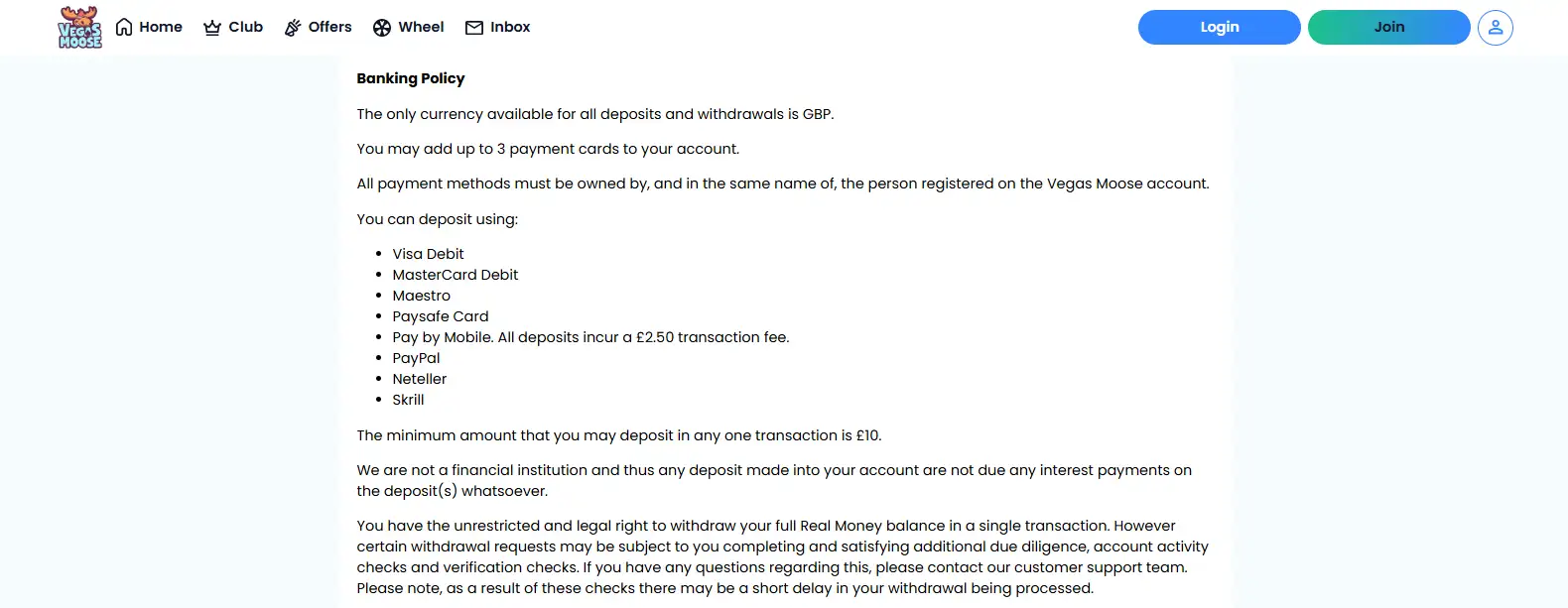
A card deposit may appear in a casino balance straight away, but that does not establish how quickly a later payout will arrive. A specialist review describes instant card deposits alongside withdrawals that can take several business days. The two stages have different processing paths, so deposit speed is not a reliable measure of access to funds after a win.
Currency is part of the transaction cost, not a display preference. Specialist review pages report that GBP is supported, but the account currency still needs confirming before the first payment. If the casino account and card transaction use different currencies, conversion may apply. The resulting exchange rate can include a spread, which may cost more than a visible flat fee.
A payment’s total cost can involve several layers: a casino charge, a payment-provider fee, an issuer or bank fee, an exchange-rate spread, or a network fee. A specialist review notes that the cheapest route cannot be identified without comparing the charges that apply to the actual transaction. A method with no stated casino fee may still involve conversion or charges elsewhere in the chain.
Bank transfers have a different timing profile. A specialist review says delivery can be affected by the bank’s cut-off time, weekends and currency conversion. Those factors matter when the account is funded from a bank rather than by card; they do not establish that a particular card will be accepted by a casino.
For anyone assessing a Diners Club deposit, the calculation therefore has two separate parts: whether the cashier accepts that card product, and what the transaction costs in the account’s currency. A Diners Club logo or a general card payment option does not settle either point. Without a confirmed route and currency, a displayed deposit amount is not necessarily the final amount charged.

Diners Club, GAMSTOP and Account Controls
A casino’s payment options do not establish whether it is connected to GAMSTOP. Diners Club acceptance, if shown in a cashier, is a payment detail; it is not evidence of a site’s self-exclusion arrangements. The same applies to claims that a casino is “not on GAMSTOP”: a card brand cannot verify that status, and no particular Diners Club casino can be identified here as covered or not covered.
These are separate checks with different consequences. Payment information concerns how an account may be funded. GAMSTOP status concerns the site’s relationship to a self-exclusion scheme. Neither can be inferred from the other, and the presence of a card logo is not a substitute for checking the operator’s published terms and account controls.
There is also a financial-limit requirement at UK-licensed remote gambling operators. Before a new customer makes a first deposit, the operator must prompt them to set a financial limit. Account-level limit controls must also be accessible. This means setting a limit is part of the account process, not a feature that depends on choosing Diners Club or another payment method.
The relevant distinction is between the casino’s controls and the payment route. A card does not remove the requirement to present limit-setting controls, and a stated limit does not confirm GAMSTOP status. Claims about “no fee” or a particular payment option likewise provide no evidence about self-exclusion arrangements.
For a UK account, the practical assessment therefore has separate parts: confirm the operator’s licensing and account-control information, establish its GAMSTOP position through appropriate operator information, and treat payment acceptance as a distinct matter. No single card label answers all three.
What is the fastest withdrawal method for UK casinos?
PayPal, open banking and debit cards linked to fast payout systems are generally among the quickest. The casino’s approval process and whether your account is fully verified also affect the wait.
Do UK casino withdrawals require verification?
Verification may be needed, particularly for a first withdrawal. Completing it can avoid delays while the casino approves the payout.
Can I deposit in GBP?
Yes, GBP is supported. Check your account currency before depositing to avoid conversion.
What is the current minimum deposit?
Minimum deposits commonly start at £10–£20, depending on the payment method. Check the cashier for the amount that applies to your selected method.
Which method has the lowest fees?
There is no universal lowest-fee method. Compare casino and payment-provider charges, any currency conversion spread, and network costs for the amount you plan to deposit or withdraw.
Which payment methods are accepted in Great Britain?
UK casino sites may offer Visa and Mastercard, bank transfers, e-wallets and, at some sites, Apple Pay. Options vary, so check the live cashier for methods available to your account.
Are Visa and Mastercard deposits definitely debit cards?
No. A network listing does not confirm that every card product is eligible; check the cashier and the terms for your card. UK gambling with credit cards has been banned since 14 April 2020.
Why must withdrawals return to the deposit method?
Returning funds to the original payment source is a common anti-fraud and anti-money-laundering control. Using another route may require additional verification.
Written by the editors at Vegas Moose Casino. 4.