
Casinos That Accept Zimpler in the UK: How to Check
 Available in GB
Availability can vary by location, account status and cashier settings, so payment pages alone may not confirm access.

Table of Contents
- How to check whether Zimpler is actually available
- Depositing with Zimpler: limits, currency and account details
- Withdrawals: where the money can go and what can delay it
- Payment alternatives when Zimpler is unavailable
- Cards and other payment routes: eligibility matters
- What a casino’s payment information can—and cannot—confirm
- Bonuses and payment methods: check the terms before counting the value
- Zimpler slots: what can be verified about the games
- Keeping deposits and withdrawals on a consistent route
- Zimpler and GamStop: the available evidence does not establish a link
How to check whether Zimpler is actually available
A casino’s general payment list is not enough to establish that Zimpler can be used for a particular account. Payment options can depend on the customer’s location, account status and the cashier’s current configuration. The useful check is the payment menu shown after signing in, not a method mentioned in a broad review or an old promotional page.
Open the cashier and inspect the available payment methods. Zimpler needs to appear as an explicit option for the account in question; a reference to mobile payments, instant banking or a similar category does not confirm that Zimpler is included. If the cashier separates deposit methods from other payment information, check the relevant menu rather than assuming a name shown elsewhere is selectable.
The timing of the check matters. A payment list can change, and a general page may not reflect current UK availability. A specialist review may list Visa and Mastercard, for instance, but that does not establish that either card is currently accepted for every UK customer or every card product. The cashier is where current availability and card-product eligibility need to be confirmed. The same distinction applies when checking whether a casino takes Zimpler: a method being mentioned in general information is not proof that it is available to the account.
When choosing a UK casino that accepts Zimpler, payment details are worth checking alongside the other factors that matter to you. The notes below provide the available payout-speed information for each option.
Payout speed: 1-3 business days Revery Play has a listed payout speed of 1–3 business days.
Payout speed: 1-3 business days Chanze has a listed payout speed of 1–3 business days.
Payout speed: 1-3 business days Jetsetspins has a listed payout speed of 1–3 business days.
Payout speed: 1-3 business days SpinFormula has a listed payout speed of 1–3 business days.
Payout speed: 1-3 business days Dieselwin has a listed payout speed of 1–3 business days.
Payout speed: 1-3 business days WinBeast has a listed payout speed of 1–3 business days.
Payout speed: 1-3 business days x3bet has a listed payout speed of 1–3 business days.
Payout speed: 1-3 business days EvoSpin has a listed payout speed of 1–3 business days.
Payout speed: 1-3 business days NightLuck has a listed payout speed of 1–3 business days.
Payout speed: 1-3 business days Britsino has a listed payout speed of 1–3 business days.
If Zimpler is absent, that is not evidence that a similarly described option is interchangeable. Payment brands and services should not be treated as synonyms. Nor does the presence of a method on a casino’s website establish that it is enabled for every customer. The practical test is whether the signed-in cashier presents Zimpler as an available choice.
Searches for Zimpler casinos in the UK can therefore produce leads, but not a final answer about current access. Before relying on a listing, compare its claim with the casino’s own cashier. If the method is not shown, or its status is unclear, the listing alone cannot settle the question. This is a narrow check: it confirms whether Zimpler is offered in the account interface, not the terms or outcome of a transaction.
A further distinction is needed for searches about Zimpler cards or debit payments. A reference to Zimpler does not by itself identify a particular card product, and a casino’s general card information cannot confirm eligibility for an individual card. Where a card is involved, its type and the cashier’s displayed options both matter. A payment method should be treated as available only when the relevant option is actually presented for that account.
Depositing with Zimpler: limits, currency and account details
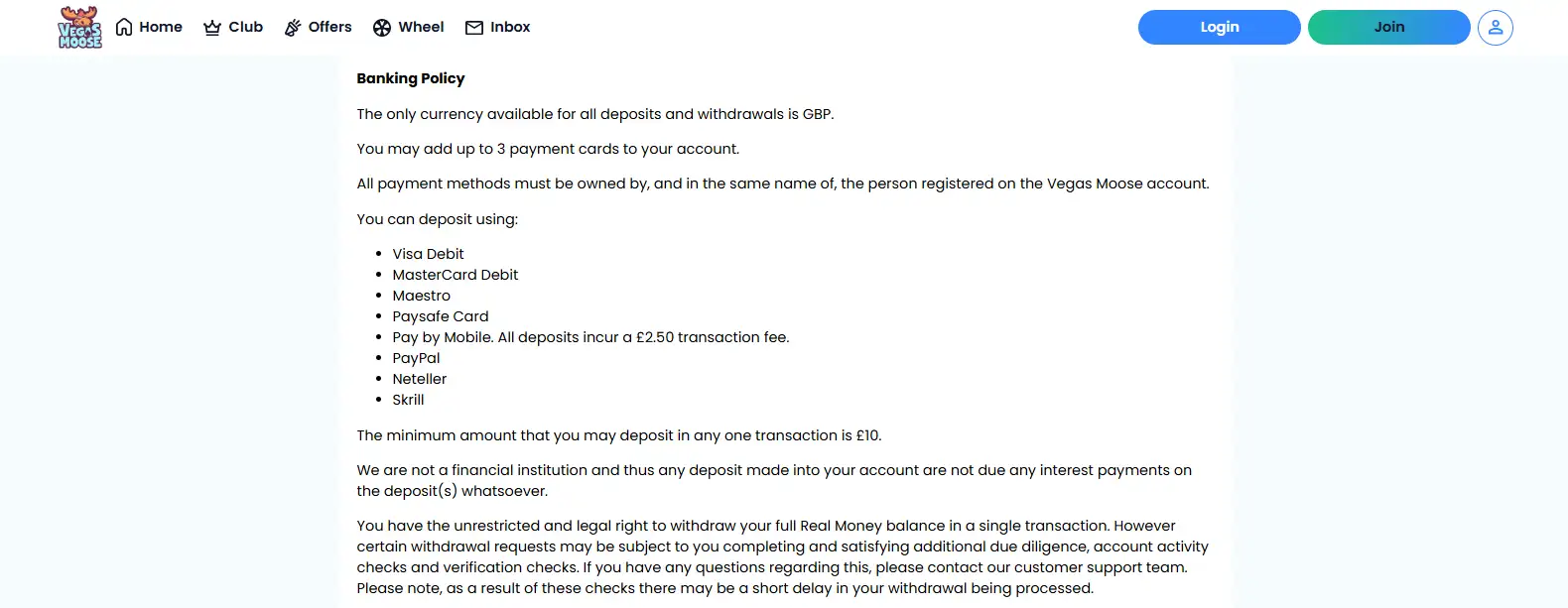
Before a Zimpler deposit, the account currency and the figures shown for that payment route need to be checked together. A specialist review of casino payment information reports GBP support, but that does not establish the currency setting for every account. Confirm the currency in the account or cashier before making the first transaction. If the account is set to another currency, conversion may apply; the amount debited and the amount credited may therefore differ.
Minimum deposits can also depend on the selected method. A specialist casino review places common starting minimums in the £10–£20 range, but that is not a guaranteed Zimpler minimum at a particular casino. The amount displayed after selecting Zimpler in the cashier is the relevant figure for that transaction. A deposit below it may not be accepted, even if the same account permits a smaller payment through another method.
Maximums need a separate check. A specialist review notes that deposit caps can apply per transaction, per day or per month, and may vary with the payment method and account status. Those are distinct limits: an amount accepted as a single deposit may still count towards a daily or monthly cap. The cashier and account controls should be checked for each applicable ceiling before submitting the payment; a general site limit does not necessarily describe the Zimpler limit.
Account details should match the payment details entered or confirmed during the transaction. A mismatch can prevent a deposit from being processed or prompt additional checks. The name, account currency and displayed payment amount should therefore be settled before authorisation, rather than corrected after a failed or incomplete transaction.
- Confirm account currency in the cashier
- Check the live minimum deposit figure
- Verify applicable transaction and daily caps
- Match account name with payment details
- Rely on general payment lists
- Assume a review’s minimum is guaranteed
- Ignore daily or monthly deposit ceilings
- Correct payment mismatches after failure
These checks answer the practical question of whether a proposed deposit fits the account and its displayed conditions. They do not establish that a particular amount will be accepted on every visit: payment terms and account status can differ. The cashier’s live figures are the basis for calculating the deposit, not a general minimum or maximum copied from a review.
Withdrawals: where the money can go and what can delay it
A deposit method does not, by itself, establish that the same route is available for a withdrawal. For a Zimpler withdrawal, the relevant condition is whether the casino offers that route for the account and transaction, and whether it can return the funds through the original payment source. The cashier’s withdrawal options and the casino’s terms determine what can be selected; a general payment list is not enough to confirm the route.
UK anti-money-laundering controls generally require a payout to go back to the source used to fund the account. This closed-loop approach also serves as an anti-fraud measure. As a result, winnings should not be assumed to be transferable to any chosen card, bank account or wallet simply because that destination is available elsewhere in the cashier.
Where the original route cannot receive the payout, the casino may offer an alternative. That does not make the substitution automatic: a different destination can trigger additional checks to establish ownership and satisfy the operator’s controls. The payment option shown for a deposit may therefore differ from the available withdrawal route. The final destination should be clear in the cashier before a withdrawal is submitted.

Payout timing has more than one component. A casino must first review and approve the withdrawal; only then does the payment provider or bank handle the transfer. A specialist review describes first withdrawals as potentially taking longer while account verification is completed. That is a timing factor, not a fixed processing promise: the casino’s approval stage and the status of the account both affect when funds leave the gambling balance.
KYC can therefore matter even when the payment details appear straightforward. If required documents have not been accepted, the casino may need to complete verification before releasing the payout. An alternative payment route may involve further checks as well. These steps can extend processing, but they do not establish a universal withdrawal time for Zimpler casinos in the UK.
A useful distinction is between the casino’s status for the withdrawal and the delivery time after approval. “Pending” or “processing” may refer to internal review; a completed casino payment can still take time to appear with the receiving provider. The cashier’s stated method, any account messages and the withdrawal status are the relevant details for identifying which stage remains.
Payment alternatives when Zimpler is unavailable
If Zimpler does not appear as a payment option, the practical alternatives are debit cards, bank transfers or a deposit-only prepaid voucher. These routes are not interchangeable: they differ in how a deposit is funded and whether the method can also serve as a route for money leaving the casino.
Debit cards are a familiar fallback. UK casinos commonly accept Visa and Mastercard debit cards, although availability depends on the casino and the card used. A card payment draws on the linked bank account rather than a credit facility. That makes it a direct alternative for funding an account, but the payment option shown in the cashier is the relevant confirmation—not the fact that a casino accepts cards in general.
Direct funding from linked bank accounts, commonly using Visa and Mastercard.
Funds move through banking channels, potentially offering instant deposits and fast withdrawals.
Prepaid vouchers used exclusively for deposits, not as a full route for cashing out.
Bank transfers and open banking offer a different route: funds move through a bank account rather than a card payment. A specialist review describes open banking and bank transfers as capable of providing instant deposits and fast withdrawals at many sites. That is a description of some operators’ arrangements, not a timing promise for every casino or bank. The specific method, availability and stated processing conditions need to be assessed at the operator offering it.
Paysafecard is a prepaid voucher, and its role is narrower. It can be used for deposits, but it is deposit-only; it should not be treated as a complete payment route for both funding and cashing out. A voucher may therefore suit a deposit where that option is available, while leaving a separate method necessary for other account transactions.
The useful comparison is not a blanket ranking of a “best” Zimpler alternative. A debit card provides a card-based deposit route; a bank transfer uses the banking channel; and Paysafecard limits its function to deposits. Which one is workable depends on the options displayed for the account and the intended transaction. A method that appears in a general payment list may not be available for every customer or every payment direction.
For a straightforward substitute, debit cards offer a widely used category, while bank-based payments may be relevant where the casino provides them. Paysafecard is more limited by design. The cashier’s available options and the method’s stated function are the deciding details; a broad claim that a casino accepts a payment type is not enough to establish that it can handle every transaction needed.

Cards and other payment routes: eligibility matters
A payment method’s name does not override the UK restriction on credit-card payments for gambling. The regulator introduced the ban on 14 April 2020, and it remains in force. UK-licensed casinos cannot accept a credit card for a gambling deposit, whether the card is entered directly or its funds are routed through a money service business.
Debit cards are a separate category. UK casinos commonly accept Visa and Mastercard debit cards, but a logo on a general payment page does not establish that every card product will work for a particular account. The cashier is the relevant place to check the available route and its eligibility. A card’s network brand alone does not show whether it is a debit or credit product.
This distinction matters when comparing casinos accepting Zimpler with casinos accepting a Zimpler card. Those phrases can point to different payment arrangements, and they should not be treated as proof that a casino accepts a particular card or funding source. Availability of a payment brand does not cancel the credit-card ban. Nor does describing a transaction as a wallet payment make credit-card-funded gambling permissible: remote gambling operators cannot accept wallet payments where the wallet allows credit-card funds to be used for gambling.
Apple Pay is another route, not a blanket exception to the rule. Some UK Gambling Commission-licensed casinos accept it for deposits. That does not mean every casino offers it, or that any payment card linked to it is eligible for gambling transactions. The operator must still comply with the restriction on credit-card payments. In practical terms, the payment method shown in a casino’s cashier and the underlying funding source both matter.
Credit Card Ban
UK-licensed casinos cannot accept credit cards for gambling deposits, whether entered directly or routed through a money service business.
The same separation applies to mobile casinos. A payment option being available through a mobile interface does not establish that it is accepted on the desktop site, or that every linked card qualifies. It confirms only the route the operator makes available in that context; card-product eligibility remains a separate question.
Payment choices also do not establish promotional terms. A casino may offer a deposit route while applying separate conditions to an offer, so the presence of a method should not be read as confirmation that it qualifies for a bonus. “No wagering” claims are likewise unrelated to whether a card payment is allowed. Eligibility for the transaction and eligibility for a promotion are different checks.
For UK players, the useful distinction is therefore not simply card versus wallet, or Zimpler versus another payment name. It is whether the specific route is offered by the licensed casino and whether its funding source is permitted. Debit-card availability, Apple Pay acceptance and Zimpler branding are not interchangeable guarantees; each describes a different part of the payment arrangement.
What a casino’s payment information can—and cannot—confirm
A casino’s payment page is useful as a statement of the methods an operator has chosen to describe. It is not a guarantee that every method is available to every customer, or that a named method will work for a particular transaction. That distinction matters when assessing whether Zimpler can be used at a UK-facing casino.

A specialist casino review may list Visa, Mastercard, bank transfers, e-wallets and cryptocurrencies as payment categories found across the websites it examined. This describes the material reviewed, not a universal set of options at every casino. Nor does a broad label such as “e-wallets” establish that Zimpler is included. A category can cover several services, with different availability and conditions.
Named payment logos are more specific, but still have limits. A page that mentions Visa or Mastercard records that the casino has published those card brands as options. It does not, by itself, confirm that either is currently enabled for UK customers, or that every product issued under the brand is eligible. Current availability and card-product eligibility need to be checked in the cashier. A general payment page cannot settle those account-level details.
The same principle applies to a Zimpler reference. A general page may indicate that an operator recognises the method, but it does not necessarily confirm that it appears for a particular account or transaction. A method could be absent from the relevant payment screen, or the displayed options could differ from those described elsewhere. Treating a logo, a general list or a broad category as final proof collapses distinct claims into one.
Those claims should be kept separate:
- Published information: what the casino says it supports in general.
- Customer availability: whether the method is offered for the account in question.
- Transaction availability: whether it is offered for the specific action being considered.
Evidence for the first claim does not automatically establish the other two. A list of deposit methods, for instance, should not be read as proof of withdrawal support; nor should an old page be treated as a current cashier screen. The wording and context of the information determine how much it can establish.
For Zimpler, the useful standard is therefore narrow: general payment information can point to a possibility, but only relevant, current account-level information can confirm availability for that customer and transaction. If a casino describes several payment methods without naming Zimpler, that description does not demonstrate Zimpler support. If it names Zimpler in general terms, that still does not establish that the option is enabled in every case.
This is not a technicality. Payment information is often presented as a compact list, while the actual choices may depend on the account and the transaction being made. The list is a summary; the available option is the operative detail. Neither should be mistaken for the other.
Published information describes what a casino supports in general, while customer and transaction availability determine if a method actually works for a specific account.
Bonuses and payment methods: check the terms before counting the value
A bonus has value only if the deposit qualifies for it and the promotion’s conditions can be met. The payment method is therefore part of the calculation, not a detail to check after a deposit. A headline offer may be available to an account but still not apply to a transaction made through a particular method.
The relevant evidence sits in the promotion terms for the specific casino and offer. Those terms should be checked for any payment-method exclusions and for the conditions that apply once a bonus is accepted. General descriptions of a casino’s cashier cannot establish that a particular deposit qualifies for a promotion. Nor does the presence of a payment option establish that using it will preserve bonus eligibility.
E-wallet treatment is not uniform
A specialist casino review describes PayPal as valued for speed and convenience, while noting that it may be excluded from bonus eligibility. The same review category reports that Skrill and Neteller are offered at some sites and are often excluded from promotions. These are reported conditions, not a rule applying to every casino or every offer; promotion terms can change, so the relevant wording must be checked at the time of the transaction.
That distinction matters when comparing a bonus with a payment method. If the terms exclude the chosen method, the advertised promotion should not be counted as part of the deposit’s value. If the terms do not state an exclusion, that alone should not be stretched into a guarantee: the offer’s remaining conditions still govern eligibility.
A useful comparison keeps the cash deposit and the promotion separate. First establish whether the payment qualifies. Then assess the offer under its stated terms, including any conditions attached to bonus funds or winnings. If eligibility is unclear, the bonus value is uncertain; treating it as cash-equivalent would overstate the account balance.
What to check in the offer wording
The promotion page and its terms should be read together. The headline may summarise an offer, while the detailed conditions determine who can use it and how. Relevant points include whether the offer applies to the account, whether a qualifying deposit is required, whether the selected payment method is excluded, and what conditions apply after acceptance. The exact terms are more useful than a general statement that a casino has bonuses.
Attention: A payment method may be excluded from bonus eligibility, meaning the advertised promotion should not be counted as part of the deposit’s value if the chosen method is restricted.
Payment-method exclusions can also make a comparison between offers misleading. One casino may advertise a larger promotion while excluding a preferred payment route; another may have a different offer with terms that permit it. Without checking both eligibility and conditions, the headline amounts do not provide a like-for-like comparison.
The payment method should not be changed solely to chase a promotion without checking the consequences. The offer may still have conditions that reduce its practical value, and the replacement method may have its own costs or transaction rules. A bonus is not compensation for an unsuitable payment route.
Zimpler and bonus claims
A Zimpler deposit does not, by itself, establish eligibility for a casino bonus. The promotion’s terms need to name the method as eligible or otherwise make clear that it is not excluded. A general claim that a casino accepts Zimpler is not proof that a Zimpler-funded deposit qualifies for a particular offer.
The same distinction applies to accounts, deposits and slots associated with Zimpler. Payment acceptance concerns the transaction route; bonus eligibility concerns the conditions of a specific promotion. Neither establishes that a particular bonus is available for that account, or that a particular game contributes towards its conditions. Those details belong in the applicable offer terms.
No Zimpler-specific bonus should be counted in a comparison unless the casino’s current promotion wording supports that conclusion. Where the terms are silent or ambiguous, the defensible figure for the bonus is not its headline value but an unconfirmed value. The deposit can still be assessed on its own terms; the promotion should remain outside the calculation until eligibility is clear.

Zimpler slots: what can be verified about the games
“Zimpler slots” can mean two different things: slot games available at a casino that accepts Zimpler, or games somehow associated with Zimpler itself. The first is a question about a casino’s game catalogue and payment options. The second would require evidence of a specific Zimpler-branded game or product. A payment method, by itself, does not establish either a particular slot title or a relationship between the payment provider and a game.
That distinction matters when comparing casinos. A site may have a large slots catalogue, but that does not show that Zimpler is available there. Conversely, a casino’s acceptance of Zimpler would not establish which games it offers. The two details need separate support; combining them in a headline does not make one evidence for the other.
A useful way to read a claim about Zimpler slots is to identify what it actually names. If it refers to games at a casino, the relevant detail is the casino’s current catalogue. If it refers to Zimpler as a game brand, the claim needs to identify the product itself. Without that distinction, “Zimpler slots” is a loose label rather than a dependable game list.
The same applies to claims about the best games, new games or mobile games at Zimpler casinos. A ranking needs identifiable titles and a stated basis for comparing them. A claim about new releases needs evidence that the named titles are new, while a mobile claim concerns whether the games can be played on a mobile device. None of those descriptions follows automatically from the payment method.
Understanding “Zimpler Slots”
A payment method does not establish a relationship with specific games. This term can refer either to the casino’s game catalogue where Zimpler is accepted or, if evidenced, a specific Zimpler-branded product.
The word “best” also needs a defined measure. It might refer to a player’s preferred theme, a game feature or a measurable characteristic, but those are not interchangeable. Without named games and comparable information, a ranking would be decoration, not analysis. The same caution applies to lists described as the best Zimpler casino games: the casino’s payment options and its game selection are separate properties.
That is not a judgment about the quality of any casino’s games; it is a limit on what the payment label can prove.
For a decision about games, the relevant evidence is the casino’s own game information. For a decision about payment, the relevant evidence is the payment information for the account and transaction. Treating one as a substitute for the other produces a category error: a method of moving money says nothing, on its own, about which reels are available.
Keeping deposits and withdrawals on a consistent route
A payment route is easier to reconcile when the casino account and the payment account belong to the same customer. Matching ownership details reduce the chance that a transaction creates avoidable questions about who supplied the funds or who should receive them. The cleanest arrangement is often one named account used consistently for deposits and withdrawals.
This is a control, not a guarantee that a transaction will pass without review. A casino may still need to establish that account details are accurate and that the payment route is being used by its owner. Consistency simply avoids adding a basic mismatch to that assessment.

Keep ownership details aligned
The account holder’s name is the first practical point of comparison. If a casino account is registered to one person while the payment account belongs to someone else, the two records do not describe a single, clear owner. That can create friction even where the payment itself has gone through.
The same principle applies to other account information used to establish ownership. Details should be accurate and consistent rather than assembled from different people’s accounts. A family member’s bank account, a shared payment profile or another person’s wallet may introduce a question that a single-owner route avoids.
This matters for Zimpler as it does for any payment method: the method’s name does not settle who owns the account or the funds. A Zimpler deposit should not be treated as a way to bypass ownership checks. The relevant comparison is between the casino customer’s details and the payment route used by that customer.
Consistency makes the transaction trail clearer
Using one named account for both sides of the transaction gives the casino a simpler pattern to reconcile. By contrast, moving between several payment accounts can make the trail less straightforward, particularly if their ownership details differ. More routes mean more details that may need to be considered; they do not automatically mean a problem, but they can make the ownership picture less tidy.
That distinction is useful when comparing casinos that accept Zimpler. A method appearing in a general payment list says nothing about whether a particular customer’s account is eligible or whether a specific transaction will be accepted. Nor does the word “instant” remove the need for a clear ownership trail. The practical question is whether the named payment route belongs to the same person as the casino account and can be used consistently.
Payment Ownership Check
- Verify casino account and payment account are in the same name
- Ensure all ownership details are accurate and consistent
- Use a single named account for both deposits and withdrawals
- Confirm the route belongs to the account holder, not a third party
A consistent route also helps separate ordinary account activity from an exception that needs explanation. If a payment account changes, the reason may be straightforward, but the change can still call for additional checks. Keeping the same route where possible reduces the number of ownership details in play. It is a small administrative advantage, not a promise about the outcome of a review.
Avoid borrowed or mismatched routes
A payment account should not be used merely because it is available if it belongs to another person. Even where that person has agreed, the arrangement does not make the casino account and payment account belong to the same customer. Consent and ownership are different questions.
The same caution applies when account details have changed. An old payment profile or an account registered under different details may not align cleanly with the casino record. Correcting the underlying information is more coherent than trying to explain away a mismatch after a transaction has been made.
Where a route cannot be used again, changing to another account may be necessary. The important point is not to assume that every alternative will be treated as interchangeable. A new route may bring its own ownership checks, and keeping records consistent makes it easier to identify what changed.
Treat the route as part of account security
A clear ownership trail supports payment security because it reduces ambiguity around the person controlling the funds. It also limits the scope for an unrelated account to become entangled with casino activity. These are basic safeguards rather than special benefits attached to Zimpler or to any particular casino app.
For UK customers, payment decisions sit alongside account-level financial controls. Remote gambling operators must prompt new customers to set a financial limit before their first deposit and provide accessible controls for managing that limit. Those controls address spending; a consistent payment route addresses ownership. One does not replace the other.

The useful standard is therefore straightforward: casino account and payment account in the same customer’s name, accurate details, and one route used consistently where possible. That will not eliminate every check, but it avoids creating an ownership puzzle before any other part of the transaction is considered.
Zimpler and GamStop: the available evidence does not establish a link
Zimpler’s presence in a casino cashier does not show whether that casino is covered by GamStop. The payment route and an operator’s self-exclusion arrangements are separate matters. A casino cannot be classified as inside or outside GamStop simply because it accepts Zimpler, and the method itself does not establish a casino’s status.
This distinction matters for searches for Zimpler casinos not on GamStop. The wording can make the payment method sound like the deciding factor, but it is not. Any claim about a particular casino’s GamStop position needs to concern that operator, not the deposit option displayed in its cashier. The same applies to claims that Zimpler casinos are unaffected by GamStop or are not registered with it.
Self-exclusion status should not be inferred from a casino’s payment page, a Zimpler logo or the availability of a particular payment route. Nor does the fact that a casino accepts Zimpler, by itself, establish that it offers a way around a self-exclusion decision. Payment access and account access are not interchangeable tests.
There is a separate account-level control that does apply to remote gambling operators in Great Britain: new customers must be prompted to set a financial limit before making their first deposit, and operators must make account-level limit controls accessible. These controls concern financial limits. They do not identify a casino’s GamStop status and should not be treated as a substitute for self-exclusion.
Accordingly, “Zimpler” is not a reliable filter for finding casinos covered by GamStop, or for finding those that are not. Any statement about a named operator’s position requires confirmation about that operator specifically. A payment method alone cannot support that conclusion.
What is the fastest withdrawal method for UK casinos?
PayPal, open banking services and debit cards linked to fast payout systems are generally among the quickest options. The casino’s approval process and your account’s verification status also affect how quickly you receive the money.
Is Skrill available?
Yes, Skrill is available at some UK-friendly casino sites. It may be excluded from promotions.
Can I deposit in GBP?
Yes, GBP is supported, but check your account currency in the cashier before depositing. If your account uses another currency, conversion may affect the amount debited and credited.
What is the current minimum deposit?
Common starting minimums are around £10–£20, depending on the payment method. Check the amount displayed in the cashier after selecting your method.
Which method has the lowest fees?
There is no universally cheapest method. Compare the casino’s charges, provider and bank fees, currency-conversion spread and any network costs for the amount you plan to transfer.
Do UK casino withdrawals require verification?
Verification may be needed, particularly for a first withdrawal, and an account that is not fully verified can take longer to receive a payout.
Why can a fast payout casino still delay my withdrawal?
A fast payment method does not skip the casino’s internal approval process. Verification, especially for a first withdrawal, can also delay the payout.
Written by the editors at Vegas Moose Casino. 4.